
Fear is our body’s prediction system for the possibility of danger. We feel fear in our bodies, and it is a visceral reaction. An instinctual response doesn’t have to be logical, and we may or may not be aware of how we feel about it.
Our bodies sense fear to rise and increase our respiration rate. Our breath becomes shallow and more rapid. This happens before we are consciously aware of what we are scared of.
By approaching our fear with curiosity, we become awake and aware of it and able to hold it with acceptance. Once we become aware of the anxiety rising, we have the opportunity to deepen and lengthen our breath. When we feel fear closing in on us, the breath is the gateway to spaciousness.
Primary Fear
My main fear is the feeling of being closed in on, trapped, or confined. I knew it was present in my psyche because, as a kid, I was scared of the dark in our Rumpus room, what we call basements in Australia. The lights would go out, and I would run up the stairs, terrified.
I didn’t realize to the extent that it played until I went to Dr. Andrew Huberman’s neurology lab at Stanford Medical School.
Dr. Huberman is the foremost researcher on our fear response. They hook you up with monitors on your chest for heart rate and your hands for sweat response. You wear VR goggles that show images of scary experiences, like swimming with sharks, walking on a beam at great heights, or being trapped in a confined space.
I can’t speak to the scientific method that they had, and they haven’t published the results yet, so I am unsure of what they discovered. I can only speak to my experience, which is subjective, but it is how I make sense of the situation.
To begin, they have you play a relatively simple puzzle. It was a timed game, and I quickly found a strategy to solve the problem.
Then they scare you with virtual reality experience. The one that got me was being trapped in a freight elevator. I was with a group of people; we walk in together, and when it stopped working, the others start to panic.
Even though I knew it wasn’t real, I was standing on a solid group in San Francisco, and I felt like I was wobbling in an elevator. We were stuck for a while, and I thought I did a good job reassuring myself that there was nothing to worry about. My rib cage tightened, and because of all the pressure, I couldn’t take a full breath of air.
Once the elevator was fixed and the doors opened, I felt an amazing sense of relief walking out and into the brightness of a sunny day. The elevator opened up, but so did my ribs, and I could take in a full breath. A weight was lifted off my shoulders.
Returning to the game, I couldn’t solve the puzzle that seemed simple a few moments ago. The strategy I devised earlier, no longer worked. I couldn’t figure it out.
My natural response was that they had changed the rules on the puzzle to make it more difficult. During the game, a dog came walking up behind me. It was a bulldog, slobbering, but unintimidating and completely distracting.
I couldn’t solve the puzzle, and I could stop thinking about the dog, even though it was behind me. I got more and more frustrated and irritable. The angrier I got, the more I tightened and shrugged my shoulders up by my ears.
I couldn’t get a good score, and I wanted so badly to improve on my score from the previous time. Then I took it to a more catastrophic level. This game is stupid. What’s the point? What am I doing this for? So I gave up and didn’t try.
Outside of this experience, I can see the same chain of events show up in other areas of my life. Something doesn’t go my way, and I search for the key to solve it, to get myself out of the trap. I get scared that I’m going to be stuck, and it gets harder to figure out. So I resign to the fact that it will never change and just give up.
Having a clear understanding of what situations are stressful, but also knowing stress where you carry in your body.
Stress reduces our capabilities. We become incapable of accomplishing a simple task.
Isn’t this what innovation is all about, solving complex puzzles? But if we are pegged emotionally, we move into space where we see ourselves as incompetent or incapable, and it is a place of shame.
Are you aware of what arises for you?
Awareness as Fear Arises
There is no separation between the body and the psyche. When this fear builds up, it comes out sideways with our impulsive reactions. Short-tempered, irritable, and frustrated with the ones you love. I know they accept me no matter what, but I am placing a more significant burden on them. My inability to process it and offload it from the system in a healthy way leads to unloading it and hurting others with it.
I don’t want to bruise the ones I love. This is not the way that leads to a place of restoring and renewing each other.
When we are in this cycle, there is no way to avoid it. It is enough to be aware of it and acknowledging that it is not the best way of dealing with the stress you are under. And apologize for taking your frustrations out on another.
Comfort with Discomfort
How do we become more comfortable with discomfort? If we can practice when the stakes are lower, it can become a training ground for when the pressure is higher.
Anxiety is our body’s forecasting system, warning that something dangerous is about to happen. It is a trained response because, in the past, something hurt us before. A similar situation has endangered us, and we don’t want it to happen again.
Fear is a protection mechanism. We self protect as a way of defending ourselves. This is either outward or inward. Withdrawl or advancing. Withdrawing is retreating in your shell. Advancing is pushing back with strong statements.
Either way, you are feeling vulnerable and want to self protect. It is essential to know that the danger hasn’t yet occurred. We just sense this is coming on.
How does insecurity show up for you?
I get scared. I’m afraid that the situation will blow up, and it will be out of control and beyond what I can handle. So I avoid it.
This tendency, avoiding a painful situation, only leads to more pain. It doesn’t resolve the situation, and the longer it remains unresolved, the more anxiety building it becomes.
It is not a good spiral, and it would be easier to deal with things when they are smaller.
An out of tune fear response gets in the way of bringing about the things I am working towards, bringing ideas into the world.
It leads to wearing down your capacity to make things happen. Before long, we catastrophize the situations and think that it is always going to be this way.
What do you lose when you have an out of tune fear response? Overwhelming situations only become more challenging. It makes me feel incapable of handling the job at hand. The situation can be overpowering.
Searching For Keys
When we moved into this house fifteen years ago, I was stuck in a continual pattern of ridiculous behavior. I would rush off, already late for work and couldn’t find my keys. It happened every day and never seemed to change.
I would run around the house like a chicken with its head cut off, looking for my keys. Id looks in the car, then in all my coat pockets. All fifty coats that I have living in Chicago. Then going through my pants pockets and screaming through the house asking what pants did I wear yesterday? Where are they?
After about a year of this, my wife had enough. Clearly, it was something that I couldn’t fix myself, so she intervened.
She cleared out a draw by the desk and said I could have it. I could fill it up with anything I want. This would be the home for my keys.
I never lost keys again.
But there was another loss. I no longer had this little leaving the house ritual, where I would stir up a big scene and get some attention. Cook up some drama to inflate my self-importance and feel like my life was worth something.
I guess I was addicted to panic. I away in was my going into a battle dance where I would psych myself up for the workday.
But over time, I came to enjoy the surprise of immediately finding my keys. It gave me peace of mind to know right where they were, and I didn’t have to wonder where they could be. There was calm that I took into my day that was different from feeling frantic.
A simple system made a world of difference.
Complex Systems
Today I came across an old key that I hadn’t seen in a while. It was under a pile of papers. It holds a lot of significance for me. Memories came flooding back. I was overcome with emotion, and tears filled my eyes.
It is a key to a prison door from Angola, Lousiana State Penitentiary. It was gifted to me a few years ago from a ministry event at the prison.
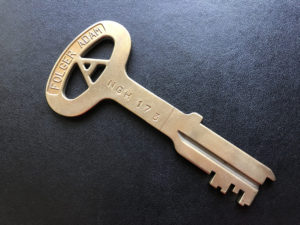
When I picked it up, the substantial weight surprised me. What the key represented weighed heavily on me.
It is the key to a metal door that keeps two black men in a small concrete box.
I thought about the men that I have come to know at Angola. Some of the finest fathers I know will be spending Father’s Day this weekend in prison.
Yes, they have committed awful crimes and deserve to serve time. They have taken lives, been involved in crimes that caused much grief and trauma. They have changed the makeup of families, sons, daughters, mothers, and fathers.
Each of the inmates I know have been through a reconciliation process where they have empathy for their victims in the crimes they have committed. They do this to engage the healing process, not to check a box or go through the motions so that they can go free.
They don’t have a path to go free. Most inmates in Lousiana don’t have a way to parole. Some victims have even testified before the parole board, saying they forgive the man who killed my son, he should go free. He is no longer a threat to society.
But the courts and criminal justice system won’t allow it.
Each of them is serving more time and being punished harder than they deserve.
How do we value life? It is impossible. But why do some states value it differently than others?
And if we say that a person that commits murder doesn’t value life, are we not also devaluing their life.
Black men are punished much harder than white men. It is not about the crime but more about your access to wealth and lawyers
The judgment is that they will never change. “Lock the door and throw away the key.” Let’s not consider their humanity because it will conflict with our tightly held judgments.
Juneteenth
All this is coming up for me today, Juneteenth. I have seen this holiday come up on my calendar and didn’t know what it was. Now I am aware that it is to commemorate the last slaves that were freed.
The sad reality is that there is still slavery in America. The connection is clear at Angola as it was once a slave plantation. Pictures from those days are in the Angola Museum. They show slaves working in fields with a guard on a horse with a rifle.
Driving around the prison, you still see the scene today. Men held against their will. Someone else’s property. Unseen as fully human.
The small change with my keys made a big difference.
I know that it will take a lot to change systematic racial inequality and the Police and criminal justice system that perpetuates it.
But we can start by acknowledging their humanity and trusting the change is possible.
Refection Question:
What makes you uncomfortable?
—
When I fear, I trust in You,
in God, Whose word I praise,
in God I trust, I shall not fear.
What can flesh do to me?
Psalm 56:4-5
—