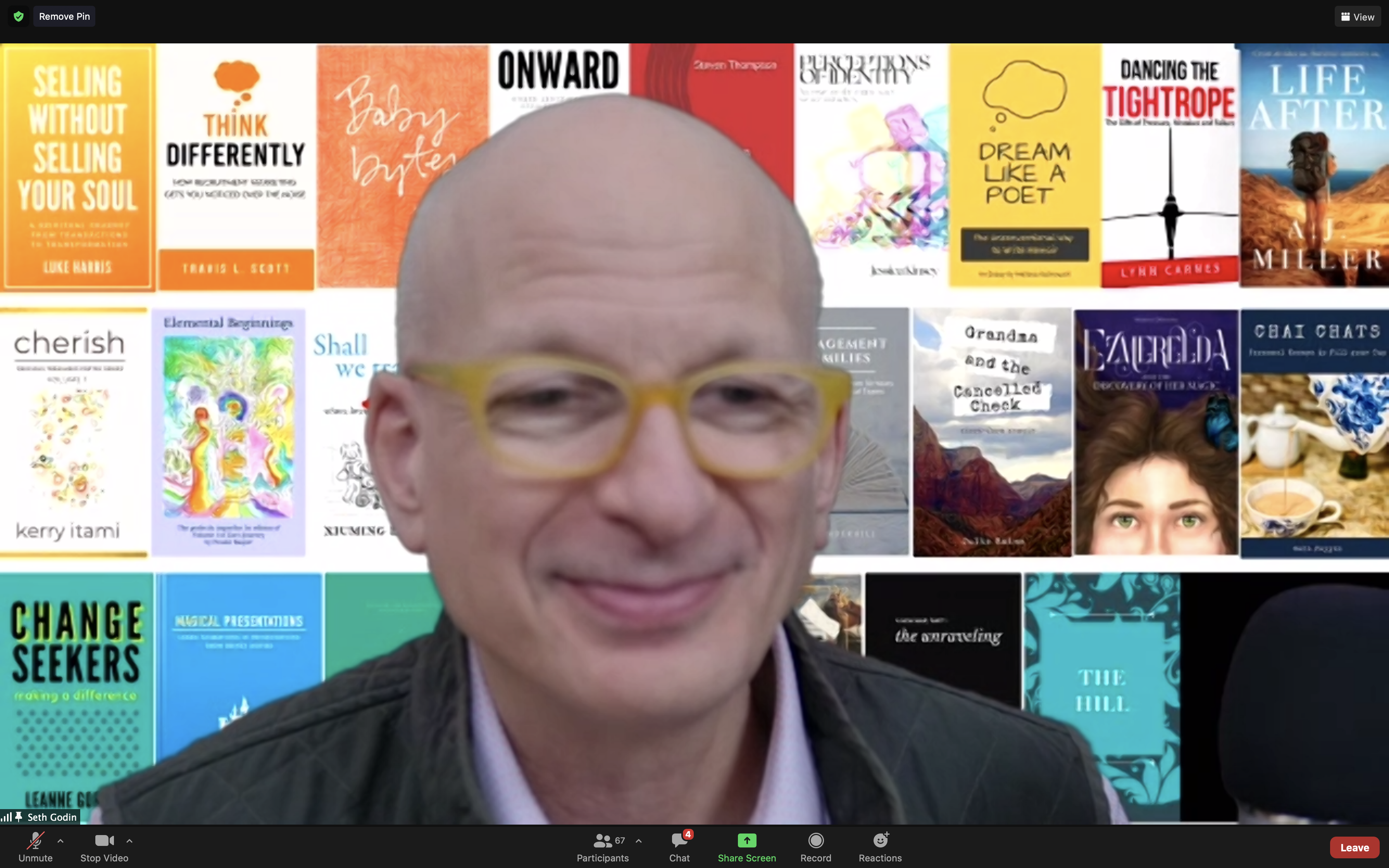
It was 2003, and the start of my selling career. I was doing a little marketing via a basic website and pay per click advertising to find clients. My manager and a few other sales folks recommended I read Permission Marketing by Seth Godin.
The book’s premise was simple: keep in touch with the people who want to hear from you with the information they value. I struggled to implement the idea with a newsletter as our market was so segmented. There weren’t many people in our market, and there were many vastly different reasons they used us. There wasn’t one message that would resonate with all of them.
I had signed up for Seth’s Blog and read his emails each day. One time I send him an email and let him know my dilemma. He responded with something that was his typical pithy, profound, and incredibly insightful.
Be the person they call when they have a problem you can solve.
As most of my work was on the phone, including cold calling, I concluded every conversation with something like, “would it be ok if I kept in touch and called you back in a couple of weeks to see if anything has changed.”
I implemented the Permission Marketing model as, find people that want to hear from you, let me know how you can help, ask if you can keep in touch, and call them back later.
I combined this strategy with Dunbar’s Number of how we can only maintain relationships with 150 people. I identified the people I wanted to keep in touch with and figured out I could talk to five people a day to get through 150 people in six weeks. I had a spreadsheet set up to if I didn’t speak to the person I tried them the following week. If we spoke, I set a reminder for six weeks.
It was simple to do, and I could fit the calls around other activities. Shortly, I saw profound effects. I would just happen to call someone, and they would have something I could help them with. Things like this would happen every day, and coworkers were complimenting me on how excellent my timing was!
This strategy frees up time in my schedule because I was more focused and effective; it also brought success.
Although something was inhibiting its potential, it depended on me, and I had a personal characteristic that was self-sabotage.
Can a blog post save your life?
I had always been competitive. The youngest of four boys, only four years between the youngest and oldest, were pretty evenly matched. Playing sports in High School was an excellent way to burn off some aggression.
Now that I had a day job, work became the only outlet. I prided myself on my competitive relentlessness as an asset in a sales career, but it was easy to overdo it. More accurately, I wasn’t competitive. I was a sore loser.
If things didn’t go my way, a customer would use someone else, I’d come after them to convince them they were wrong even though it was futile.
It was into one of these moment’s that Seth dropped a post that landed in my gut. Talk about how you respond to “no” he writes:
You could be more gracious than if you’d won the work. You could send a thank you note for the time invested, you could sing the praises of the vendor chosen in your stead and you could congratulate the buyer, “based on the criteria you set out, it’s clear that you made exactly the right choice for your organization right now.” That doesn’t mean the criteria were right, it just means that you’re not attacking the person for being an impulsive lunatic. You could even outline what you learned from the process and what you’ll be changing in the future. And you can make it clear that you’re in it for more than just a sale, and you’ll be around if they ever need you.
Seth Godin
Two ways to deal with “no”
December 20, 2008
I read these words from a customer’s parking lot moments after hearing the devastating news that I had lost an order. I remember feeling so pissed off and then instantly changing my mind. On the way home, I stopped and picked up a box of generic, blank Thank You cards.
Later that day, I sent a handwritten note to the customer. Over the next couple of months, I sent another eight or ten to others, and for years I have used it for email reply when I’ve lost a piece of business.
Not only has it helped me become more gracious in loss, but it has also helped me understand the customer’s perspective. When I can acknowledge how they made the right decision to use someone else, I can get curious about what the reasons may be. By understanding the decision from the customer’s perspective, I am better able to help get what they need from us in the future.
The Inspiration Continues
In Seth’s book Tribes, he referred to the Grateful Dead and a particular show. Not too long after I read the book, a new version of the performance circulated in trading circles. I put the high-resolution music files of a few shows on a DVD and sent them out to him. He responded by sending a box of his books to my house, signed with references to the Grateful Dead.
There was also the time in 2009 I randomly looked up Seth’s Wikipedia page. It was his birthday that very day! So I shot him a message, wishing him a happy birthday.
It turns out I got the month wrong. It was June when his birthday was in July. Instead of making me feel like a dumb arse, he responded by saying:
I have a great birthday every day. My real birthday is next month, but I’ll enjoy today even more because you thought of me.
The following year for his birthday, he posted It’s Not My Birthday, where he donated his birthday to raise money for Charity:Water. It showed me how a generous person could become even more generous.
One of the most inspiring things he led me to become took me by surprise. My typical decision tree for navigating the day usually goes… What’s for lunch?… Where’s the meat?
At one of Seth’s events, The Acoustic Tour, where he stood on stage at a beautiful theater and told story after story. It was captivating.
It was downtown Chicago. I thought a great lunch would take things over the top. Seth was excited to tell us he catered a special lunch, sushi! He mentioned how he went to so many events, and the food was awful, but at his event, he wanted to have the food he liked.
It shocked me. I love sushi, almost as much as steak.
It was short-lived. When I got out to the lunch table to find out, it was vegan sushi. How is that even a thing? I wondered. I was a total disconnect as I wondered how Seth could be one of those people.
While I waited in line, a lady returned to the theater with a McDonald’s bag, and I envied her ingenuity. I couldn’t smell the fries across the atrium, but I sure could taste them.
Always willing to try new things, I ate the food based on my great trust in Seth. I was so inspired and thinking if Seth is one of those people, and he’s not that bad, I might be able to be one too.
So I decided to become a vegan. I do it every day for about 8-12 hours, mostly while I’m asleep. My favorite plant-based protein is a grass-fed rib eye!
Around this time, I worked at a factory. Even though I was in the front office, I could see that I was still just a cog in the machine. Seth writes a lot about a factory worker and how to break out of the mold to become indispensable. It is about leveling up as a leader and finding ways to learn and grow to create more value with your work.
It led me to the altMBA and the Akimbo workshops he founded.
My Favorite Question
This year my favorite question has been, “Hey Siri, how many days since February 5?”
Today she replied, “It was three hundred and eight days ago.”
The date marks the start of The Creatives Workshop the Seth build and based the book The Practice on. The challenge for the workshop was to write a piece and post it publicly for one hundred days.
This seemed so daunting. I didn’t know what I would write because I didn’t think I had anything to say.
Over time and with support from others, I kept writing. I made it past the one hundred days and have kept ongoing. Seeing others do the writing gave me ideas of things to write about. People were reading and responding and pushing me to dig deeper. It gave me more things to write about.
I ended up writing so much I wrote my way into writing a book. I have always wanted to become a writer, and this year it became a reality because I found others to do the work with. It feels like someone tricked me into becoming an author!
Having people to write with has been really fun. But having people read me stuff and respond thoughtfully and with encouragement has changed me. It has helped me share what’s on my heart via the written word, but it has also helped me see how we connect with one another.
2020 will go down as one of the most challenging years for me and most of humanity. When I look back on the year, I can’t help but see the sweetness of community, all who were drawn to Seth’s work is what will make this year remarkable.
It was an honor to be included with the twenty people who published a book in the workshop on December 21. But there were many others in the community to support me and provided accountability to stay consistent. Drip by drip, I wrote a book, and I couldn’t have done it without the community.
__+__